Breathing Bag: Why Sterilization Packaging Has to Breathe
Release time:2026-10-28
Visits:0
A breathing bag is a sterilization pouch with one non-negotiable property: it has to let sterilant in and keep microorganisms out. The name comes from that behaviour. During a steam or ethylene oxide cycle the pouch breathes — gas and vapour pass through the porous face, the load is sterilized, and after the cycle the same porous structure acts as a microbial barrier.
Get the porous side wrong and the load either fails to sterilize or fails to stay sterile. Wuxi Harmake Technology Co., Ltd. produces
breathing bag rolls in a Tyvek 1073B and HDPE construction, manufactured in ISO 5 and ISO 7 environments, for hospital and pharmaceutical sterilization use.
The Two Faces of a Breathing Bag
A
breathing bag is a laminate of two dissimilar materials, and the asymmetry is the entire design.
• The porous face. Tyvek 1073B, a flash-spun high-density polyethylene sheet. Its fibre network has pores small enough to stop bacteria but open enough to pass steam and EO. It does not shed fibres the way paper does, and it does not absorb liquid.
• The transparent face. HDPE film. It lets you see the contents and the indicator, it holds the printed information, and it provides the strength.
The pouch is sealed on three sides, or on two sides when made from a roll. The seal joins the two faces, and the peel at the point of use separates them along that seal.
Why Not Paper
Paper pouches work and are cheaper. They also shed fibres, absorb moisture and lose strength when wet, which is exactly the condition inside a steam sterilizer. Tyvek keeps its strength wet and dry, and produces a cleaner peel. For aseptic presentation in a pharmaceutical or surgical setting, that difference is decisive.
Steam, EO and Irradiation
A
breathing bag must be validated for the sterilization method it will actually see, and the three common methods stress it differently.
|
Method |
Conditions |
What the bag must do |
|
Steam |
121 °C, 30 psi, 30 minutes |
Pass steam and condensate, survive the pressure cycle without seal failure |
|
Ethylene oxide |
37 to 55 °C with humidity |
Pass gas, allow aeration, resist chemical attack |
|
Irradiation |
Gamma or e-beam |
No porosity requirement, but film stability and no embrittlement |
Harmake's breathing bags are specified for steam at 121 °C and 30 psi for 30 minutes, and are also suitable for EO and irradiation. Confirm the cycle parameters against your sterilizer's validated cycle — a bag rated for 121 °C is not automatically rated for a 134 °C flash cycle.
Condensate Is the Real Enemy
Steam sterilization leaves condensate, and condensate sits in the pouch. A pouch that is packed too tight, or a roll-made pouch with no air gap, holds water against the item and the seal. Load configuration matters as much as pouch specification: stand pouches on edge, porous side facing the same direction, and never stack them flat on top of each other.
Roll Format Versus Pre-Made Pouches
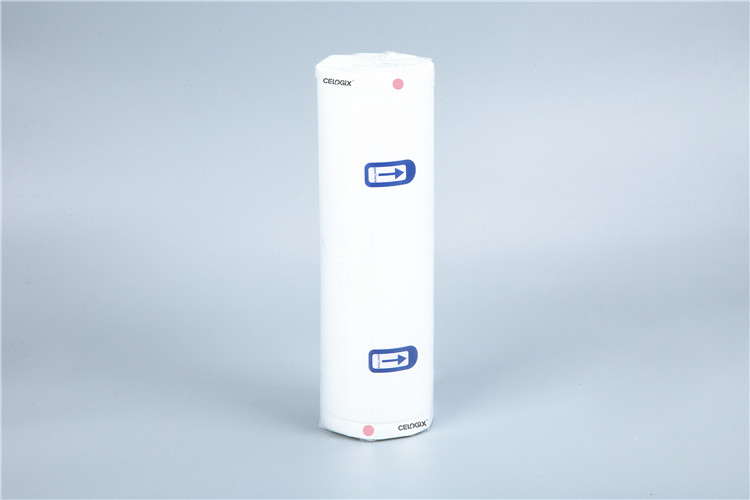
A roll is a length of tubing with one sealed edge, cut and sealed to length at the point of use. Harmake supplies rolls in 300, 400, 500, 600, 800 and 1000 mm widths, 100 m per roll, one roll per carton.
When a Roll Wins
• Irregular contents. Instruments and component sets that do not fit standard pouch sizes.
• Inventory control. Six roll widths replace dozens of pouch SKUs.
• Cost per pouch. A roll is cheaper per unit length than a pre-made pouch of the same width, provided the site has a sealer and the discipline to use it.
When a Pre-Made Pouch Wins
• Throughput. Cutting and sealing by hand is slower than grabbing a pouch.
• Consistency. A factory seal is more reproducible than a bench seal made at the end of a shift.
• Validation. A pre-made pouch arrives with its seal already validated; a roll-made pouch depends on your sealer, your operator and your parameters.
Sealing a Roll Correctly
Three parameters, recorded every shift:
• Temperature. Set per the film, verified with a seal-integrity check, not by eye.
• Dwell time. Too short gives a weak seal; too long embrittles the film edge.
• Pressure. Uneven jaw pressure produces a seal that holds on one side and channels on the other.
Seal width should be at least 8 mm to 10 mm for a steam pouch. Cut with a cutter designed for the roll; scissors leave a ragged edge that starts a tear.
Width Selection
The roll width must exceed the item's largest dimension plus a fold allowance, typically 30 mm to 50 mm on each side. An item packed tight against the seal stresses the seal during handling and prevents steam from circulating around it.
|
Item type |
Typical roll width |
|
Small components, single instruments |
300 mm |
|
Instrument sets, small trays |
400 to 500 mm |
|
Component kits, multiple items |
600 mm |
|
Large trays, equipment covers |
800 to 1000 mm |
Bioburden and Storage
A sterilization pouch is not sterile when it arrives. It is clean, and it carries a controlled bioburden that the sterilization cycle is designed to reduce to the required sterility assurance level.
Ultra-clean Breathing Sterilization Pouch Roll Bag
Harmake's
breathing bags are produced in ISO 5 and ISO 7 environments, with bioburden monitored to ISO 11737-1, biocompatibility assessed to ISO 10993-18, and environmental management under ISO 14001. That documentation supports the site's own bioburden budget.
Storage practice decides whether the effort is wasted:
• Keep rolls in the original carton, sealed, in a dry room at controlled temperature.
• Do not store rolls on the floor or against an outside wall where condensation forms.
• Do not open a roll until the sealing station is ready.
• Respect the expiry date; the porous face ages.
• Keep the sealing area clean; dust on the jaw becomes a channel in the seal.
What to Check Before Buying
|
Question |
Why |
|
Tyvek grade stated? |
1073B is the common medical grade; substitutes behave differently |
|
Sterilization methods validated? |
Steam, EO and irradiation are separate validations |
|
Roll width and length per carton? |
Matches item range and changeover frequency |
|
Production environment? |
ISO 5 and ISO 7 production supports bioburden control |
|
Bioburden and biocompatibility data? |
Needed for the site's own validation file |
|
Sealer compatibility? |
Jaw width, temperature range and cut method |
A breathing bag is a small piece of packaging that carries a large responsibility. It has to breathe during the cycle, seal afterwards, peel cleanly at the point of use and present the contents without adding particles. Tyvek on one side and HDPE on the other is the construction that does all four — provided the roll, the sealer and the load configuration are chosen together.