Sterile Sleeves: Closing the Gap Between Glove and Coverall
Release time:2026-10-28
Visits:0
Look at where contamination events start in an aseptic suite and a pattern appears: the wrist, the forearm, the point where the glove cuff meets the coverall sleeve. That joint is the weakest part of the gowning system because it is the part that moves most.
Sterile sleeves exist to cover it properly, and they are specified far less carefully than the gloves they sit next to.
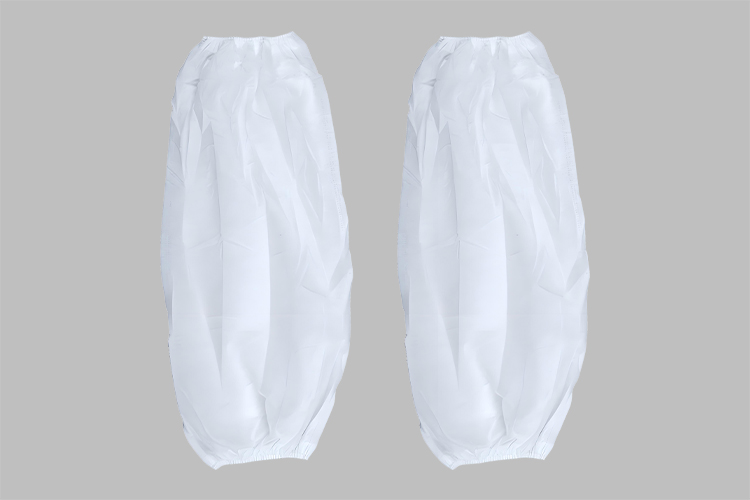
Wuxi Harmake Technology Co., Ltd. supplies sterile sleeves and clean sleeve covers in polypropylene non-woven for ISO 7 and GMP Grade C environments, alongside the gloves, coveralls and boot covers they have to integrate with.
Why the Forearm Is a Weak Point
Three mechanisms drive it:
• Movement. The wrist rotates through a wide arc. A sleeve that is not anchored at both ends works its way up the arm within minutes.
• Contact. Forearms rest on bench edges, reach into ports and brush against transfer containers. That is direct contact with surfaces that may not be sterile.
• Particle release. Fabric flexing at the elbow and wrist releases particles right above the work zone, which is the worst possible location.
A sterile sleeve converts an exposed forearm into a controlled surface. It does not sterilise the arm; it provides a barrier that can be replaced between interventions.
Length, Fit and the Two-End Anchor
A sleeve that is anchored at one end only will fail. Both ends need to grip:
• Upper end sits over the coverall sleeve, held by elastic or a tie, above the elbow.
• Lower end sits over or under the glove cuff, depending on the gowning convention, and must not bunch at the wrist.
Length is measured from mid-upper-arm to wrist. A short sleeve that stops at the elbow leaves the forearm — the part that actually touches things — uncovered.
Sleeve Over Glove or Glove Over Sleeve
Both conventions are used, and the choice should be written into the gowning SOP rather than left to the operator:
|
Convention |
Advantage |
Risk |
|
Sleeve over glove cuff |
Liquid runs off the sleeve, not into the glove |
Sleeve edge can lift during wrist rotation |
|
Glove over sleeve cuff |
Glove stays seated, better tactile continuity |
Splash can enter between glove and sleeve |
In aseptic filling, glove over sleeve is more common because the glove cuff is taped or gripped and the sleeve cannot migrate. In splash-heavy work, sleeve over glove drains better. Pick one and audit against it.
Material Performance
Harmake's sterile sleeves use multi-microporous breathable polypropylene non-woven, which brings four properties that matter in a Grade C room:
• Breathability. Long procedures in a full gown are physically demanding. A breathable sleeve reduces heat accumulation on the forearm, which is where operators notice it first.
• Liquid splash resistance. The microporous structure resists splashes without becoming a condensation trap, which is the trade-off a solid film cannot avoid.
• Low particle shedding. The fibre structure holds shed particles rather than releasing them at every movement.
• Antistatic performance. The material passes antistatic testing to a surface-resistance specification, which matters in areas handling powders, solvents and flammable liquids.
Reinforced Edging
The cuff and the upper hem take the most abrasion. Reinforced edging sewing keeps the hem from fraying, and a frayed hem is both a particle source and a visual audit finding. It is a small manufacturing detail that separates a usable sleeve from a cheap one.
Clean Versus Sterile Sleeves
The distinction follows the same logic as gloves:
•
Clean sleeve covers are produced in a cleanroom environment and packed to a Class 1000 cleanliness standard. They suit Grade D and ISO 8 areas and general controlled environments.
• Sterile sleeves are individually packed and sterilized, for use at Grade B boundaries and in aseptic interventions.
A clean sleeve in a Grade A zone is a deviation. A sterile sleeve in a warehouse is money spent for nothing. Match the format to the classified area, not to the item's importance in the catalogue.
Donning and Doffing
Sequence for a sterile sleeve at a Grade B boundary:
1. Perform hand hygiene and don the inner sterile glove.
2. Open the sleeve pack at the boundary, touching only the outer wrapper.
3. Slide the sleeve up the arm, gripping only the inside of the upper hem.
4. Seat the upper elastic above the elbow, over the coverall sleeve.
5. Don the outer sterile glove over the sleeve cuff and tape or grip as per SOP.
6. Sanitize the outer glove before entering the critical zone.
Removing the Sleeve Safely
On exit, remove the outer glove first, then the sleeve inside-out, then the inner glove. Removing the sleeve before the outer glove drags a contaminated surface across the wrist.
When Sleeves Are the Wrong Answer
Sleeves are a supplement, not a substitute. Choose long-cuff gloves or a gown with integrated sleeves instead when:
• The intervention is short and the wrist is the only exposed area.
• The process involves fine manipulation where a second layer at the wrist would destroy tactile feedback.
• Solvent exposure is heavy enough that a non-woven sleeve would wet through; a coated or film sleeve is the right product.
Specification Checklist
|
Item |
Target |
|
Length |
Mid-upper-arm to wrist, with elastic at both ends |
|
Material |
Multi-microporous breathable PP non-woven |
|
Liquid resistance |
Splash resistant without losing breathability |
|
Particle and static |
Low shedding, antistatic test passed |
|
Edging |
Reinforced stitching at cuff and hem |
|
Formats |
Clean bulk pack plus individually packed sterile |
|
Packing environment |
Class 1000 or better, confirmed by the supplier |
Harmake supplies H3-CS01 clean sleeve covers in packs of 10 (100 packs per carton) and H3-CS02 sterile sleeves individually packed, both in polypropylene non-woven with reinforced edging and antistatic performance, for ISO 7 and GMP Grade C areas.
Health Sterile Disposable Sleeves and Arm Covers
Harmake supplies both the clean and the sterile format from the same non-woven, so a site can standardise on one feel and one fit across Grades C and D. The forearm is where gowning discipline quietly breaks down. A correctly sized, properly anchored
sterile sleeve is one of the cheapest ways to close that gap — provided it is chosen for the classified area it will actually be worn in.