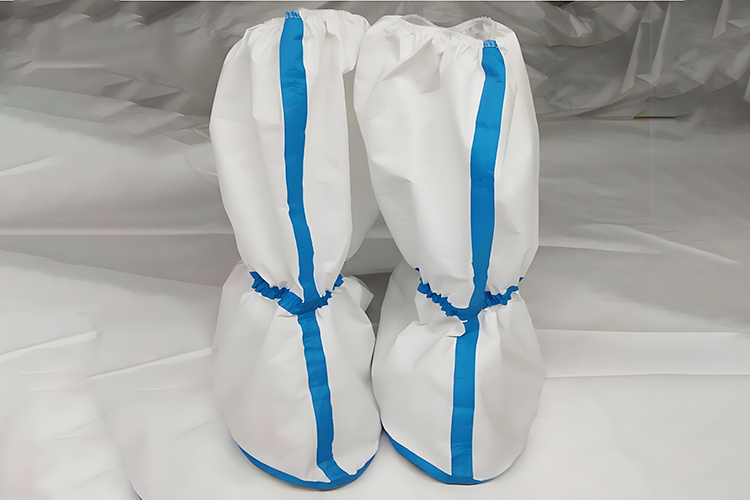
Boot Covers: A Procurement Guide, Not a Product Description
Release time:2026-10-28
Visits:0
Boot covers look like the simplest item on the gowning list. They are also the item with the highest consumption rate and the shortest decision cycle, which is why they are usually bought on price and then complained about for a year. This article treats them as what they are: a consumable with a material choice, a consumption rate, a dispensing problem and a waste stream.
Wuxi Harmake Technology Co., Ltd. produces boot covers and high-top anti-slip variants within its cleanroom contamination control range, in both clean and aseptic formats.
Material: Polyethylene Versus Non-Woven
There are two real options, and they behave differently enough that mixing them across a site causes confusion.
|
Property |
Polyethylene (PE) film |
Polypropylene non-woven |
|
Water resistance |
High |
Moderate, splash resistant |
|
Breathability |
None |
High, microporous structure |
|
Particle shedding |
Higher, especially at the seams |
Lower, fibre structure retains particles |
|
Slip resistance |
Poor when smooth |
Better with textured sole |
|
Noise |
Noticeable when walking |
Quiet |
|
Cost |
Lowest |
Higher |
|
Best for |
Short interventions, wet zones, visitors |
Full shifts, GMP areas, particle-sensitive work |
The mistake is choosing PE for a full shift in a Grade D area. It is cheaper per piece and more expensive per shift, because the foot overheats, the operator removes the cover at the first break, and the cover is replaced two or three times instead of once.
Gram Weight and the Tear Question
Disposable Protective High-Top Non Slip Boots & Shoes Covers
Non-woven
boot covers are sold by gram weight. Lighter material is cheaper and tears at the heel when pulled over a boot. If your deviation log shows covers splitting at the heel or the toe seam, the answer is usually a heavier grade or a larger size, not a different supplier.
Consumption Is a Gowning Design Problem
A typical site uses two to four pairs per operator per shift: one for entry, one after each exit and re-entry. Over a year, on a 40-person shift pattern, that is a five-figure piece count. Two decisions change it materially.
Area-Dedicated Footwear Instead of Covers
Where the process allows, dedicated shoes that stay in the clean side remove the cover from routine entry entirely. Covers are then used only for visitors, maintenance and emergencies. The capital cost is recovered within a year on most sites, and the particle profile improves because there is no disposable seam flexing at every step.
Dispensing at the Point of Use
Covers stored in a distant store room get fetched in batches, carried through clean areas in an outer carton, and stored on the floor. Dispense at the change room bench, in the packaging the supplier intended, and keep the outer carton on the dirty side.
|
Dispensing approach |
Effect |
|
Loose covers in a bin |
Cross-contamination, miscounts, covers on the floor |
|
Pack of 10 opened at the bench |
Practical for most Grade D rooms |
|
Individually packed sterile |
Required at aseptic boundaries, costly elsewhere |
|
Wall dispenser |
Good control, needs a suitable pack format |
Sterile Versus Clean Boot Covers
A sterile boot cover is not simply a cleaner version of a clean cover. It is a different workflow:
• The outer pack is opened in the outer change room.
• The inner pack is opened at the aseptic boundary, by an operator wearing sterile gloves.
• The cover is donned without the sterile glove touching the floor or the outside of the cover.
• The used cover is removed inside-out and disposed of before leaving the area.
Doing this correctly takes practice. Doing it with a clean cover in a Grade B area is a deviation waiting to be written.
For Grade D and ISO 8 areas, a clean cover produced and packed in a controlled environment is sufficient. Harmake's clean boot covers are produced in a cleanroom environment with packaging meeting a Class 1000 cleanliness standard, which is the level most Grade D change rooms can defend in an audit.
Fit, Sizing and the Ankle Interface
Three fit details cause most complaints:
• Length. The cover must reach above the ankle and sit over the trouser leg, not under it. Tucked-in covers open at the first deep step.
• Sole width. A cover sized for a narrow shoe will not sit flat on a wide safety boot, and an unflat sole is a slip risk.
• Cuff tension. Too tight and it cuts circulation on a long shift; too loose and the cover rotates.
Buy two or three sizes rather than one "universal". The saving from a single size is small compared with the cost of covers that fail in use.
Waste Handling
Used covers are contaminated on the outside by definition. In a Grade D area they go into the change room waste stream. In a potent-compound facility they may require segregated disposal. Either way, the bin should be inside the change room, positioned so the operator can remove and dispose without walking back into the clean side.
Flatten the cover before disposal if the waste contractor requires volume reduction. Do not compress by hand in a clean area — that aerosolises whatever the sole picked up.
A Practical Specification
|
Requirement |
Recommendation |
|
Material |
Multi-microporous breathable PP non-woven for shift-length wear |
|
Sole |
Textured non-slip surface, suitable for wet flooring |
|
Closure |
Bound ankle or elasticated cuff, reinforced stitching |
|
Particle and static |
Low shedding, antistatic test passed |
|
Packing |
Class 1000 environment or better, stated in writing |
|
Formats |
Clean bulk pack plus individually packed sterile option |
|
Sizes |
At least two sizes covering the site's boot range |
Harmake supplies clean
boot covers in packs of 10 (100 packs per carton) and aseptic boot covers individually packed, both in polypropylene non-woven with a non-slip sole and a bound ankle, for ISO 8 and GMP Grade D environments. The high-top variant adds ankle coverage where a standard cover tends to migrate.
Harmake supplies both formats with the packing cleanliness level documented, so the clean and aseptic lines can be told apart on paper as well as on the shelf. Boot covers are cheap per piece and expensive per deviation. Specify the material against shift length, control dispensing at the bench, and keep a sterile format on the shelf for the days when the boundary actually matters.