High-Top Non-Slip: Specifying Boot Covers That Stay Put
Release time:2026-10-28
Visits:0
Walk into any cleanroom and you will find the same three complaints about footwear: the cover slips off the heel, the sole slides on a wet floor, and the ankle gap lets particles out. All three are specification failures, not user error. The phrase high-top non-slip describes the two features that address them — a raised ankle section and a sole with a friction surface — and both need to be defined properly before you buy.
Wuxi Harmake Technology Co., Ltd. manufactures
high-top non-slip boot covers in clean and aseptic formats for ISO 8 and GMP Grade D environments, as part of its cleanroom contamination control range.
What "High-Top" Is Actually Solving
A standard shoe cover sits at the instep. It leaves the sock and trouser cuff exposed, and it relies on an elastic band around the shoe itself to stay on. In a change room, that band is exactly where the cover fails: it rolls, it creases, and the cover migrates backwards with every step.
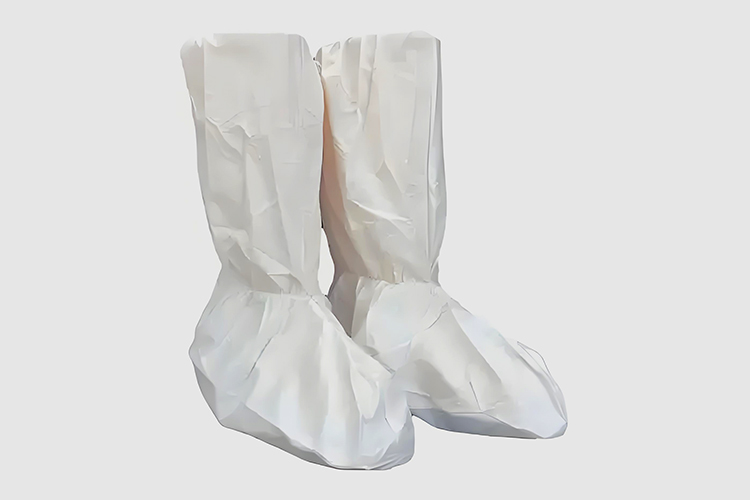
A high-top design extends the cover up the ankle and closes with a binding cord or elasticated cuff above the ankle bone. Three practical consequences follow:
• The cover stays on. Load is taken at the ankle rather than at the shoe rim, so walking does not pull the cover off.
• The ankle gap closes. The transition from trouser cuff to footwear is where particle shedding concentrates. A high-top cover covers that joint.
• The seal is visible. An operator can see whether the cuff is properly seated before leaving the change room. A low cover gives no such cue.
Binding Cord Versus Elastic Cuff
A binding cord with reinforced edge stitching holds position better and is adjustable, which matters when one size has to fit several operators. An elastic cuff is faster to don and better for high-throughput change rooms. Neither is universally right; pick based on whether the bottleneck is fit or speed.
Slip Resistance: What to Ask For
"
Non-slip" is a marketing word until it is tied to a test. A disposable cover is a film or non-woven layer sitting between the operator's shoe and the floor, and it changes the friction between them. Two surfaces matter:
• Dry floors. Most covers perform acceptably dry. Failures here are usually caused by a loose fit, not by the sole material.
• Wet or freshly mopped floors. This is where slip incidents happen. A smooth polyethylene cover on a wet vinyl floor is close to ice. A textured or embossed sole, or a non-woven with a friction coating, makes a measurable difference.
Ask the supplier for the sole construction and, where available, a coefficient-of-friction test result on the floor types in your facility. If no data exists, run your own comparison: ten operators, a wet floor section, and a standardised walking route will tell you more than a datasheet.
The Real Risk Is Not the Fall
A slip that does not cause a fall still causes a contamination event: the operator grabs a door frame, a wall or a bench to recover. In a Grade D area that is a surface contact that nobody records. Reducing slip is as much a contamination control measure as a safety measure.
Material and Comfort
Harmake's high-top non-slip boot covers are made from multi-microporous breathable polypropylene non-woven. The structure is worth understanding because it explains the trade-offs:
Disposable Protective High-Top Non Slip Boots & Shoes Covers
• Breathability. Air passes, moisture vapour passes, so the foot does not become a condensation trap during a long shift.
• Particle retention. The microporous structure holds shed particles rather than letting them escape at every step.
• Strength. Non-woven resists tearing better than a plain polyethylene film, which matters when the cover is pulled over a boot with a heel.
• Antistatic performance. The material passes antistatic testing, which is relevant in areas handling powders and solvents.
A polyethylene cover is cheaper and more water-resistant. It is also hotter, noisier and more slippery. For a short intervention in a dry area, polyethylene is fine. For a full shift in a GMP environment, breathable non-woven wins on both comfort and particle control.
Where These Covers Belong
|
Area |
Suitable format |
Notes |
|
ISO 8 / GMP Grade D |
Clean high-top non-slip cover |
Standard change room item, changed per entry |
|
ISO 7 / GMP Grade C |
Sterile or sanitized cover |
Donned at the boundary, not in the outer change room |
|
Aseptic core |
Sterile, individually packed |
Handled with sterile gloves only |
|
Warehouse and logistics |
Low-cost cover or dedicated area shoes |
Consider area-dedicated footwear instead |
Aseptic covers are individually packed because the outer pack is opened in the outer change room and the inner pack at the boundary. That two-stage opening is the whole reason individual packing exists.
Change Room Sequence
The order matters more than the product:
1. Remove outdoor shoes at the bench and step into the clean side.
2. Don the coverall, then the hair cover, then the mask and goggles.
3. Don boot covers last among garments, sitting down, with the cuff sitting over the trouser leg — not tucked inside it.
4. Sanitize gloved hands after touching the cover packaging.
5. On exit, remove covers before leaving the change room, inside-out, and dispose in the designated bin.
Two Habits That Prevent Most Problems
Sit down to don covers — standing on one leg is how people tear a seam and fall. And never walk from the dirty side back to the clean side to fetch a forgotten cover; keep a spare pack at the bench instead.
Specification Checklist
|
Item |
Target |
|
Ankle closure |
Binding cord with reinforced stitching, or elasticated cuff |
|
Sole |
Textured or embossed non-slip surface, tested on wet flooring |
|
Material |
Multi-microporous breathable PP non-woven for long shifts |
|
Particle and static |
Low particle shedding, antistatic test passed |
|
Packing environment |
Class 1000 or better, stated by the supplier |
|
Sizes |
Range covering the site's shoe sizes without over-stretch |
|
Sterile option |
Individually packed aseptic version available |
Harmake supplies H3-SC01 clean high-top anti-slip boot covers in packs of 10 (100 packs per carton) and H3-SC02 aseptic high-top anti-slip covers individually packed. Both use polypropylene non-woven with a non-slip sole, a bound ankle and reinforced edge stitching, and are produced in a cleanroom environment for ISO 8 and GMP Grade D use.
Harmake produces both formats in a cleanroom environment and states the packing cleanliness level, which is the detail auditors ask about first. Footwear is the part of the gowning procedure everyone rushes. It is also the part that touches the floor, which is the dirtiest surface in the suite. A high-top non-slip cover that fits and grips is a small purchase that removes a recurring source of deviations.