Flexible Isolator: A Working Guide to Soft-Wall Aseptic Containment
Release time:2026-10-28
Visits:0
A flexible isolator is not a small cleanroom. It is a pressure-controlled film enclosure that draws a sterile boundary around one task — weighing a potent powder, filling a small batch, or handing a container into a reactor port. Once that distinction is clear, most of the argument about whether a flexible isolator is "good enough" for a given process answers itself.
Wuxi Harmake Technology Co., Ltd. builds
flexible isolators as part of its containment protection range, alongside the powder transfer and single-use bag systems that usually sit next to them on the same skid. This article covers what the enclosure actually does, how to size it, and the maintenance habits that decide whether it stays inside its specification.
What a Flexible Isolator Actually Is
The enclosure is a transparent flexible film — usually PVC or a weldable polymer sheet — stretched over a rigid frame or inflated to shape. Film thickness is typically in the 0.3 mm to 0.5 mm range, which is thick enough to hold pressure and thin enough to let an operator see what their hands are doing.
Film, Frame and Glove Ports
Three components decide whether the unit is usable:
• The film sets the pressure envelope and the working life. It creases, it ages, and it must survive the disinfectant you actually use, not the one on the datasheet.
• The frame sets the footprint and whether the unit folds down. A folding frame is the difference between an enclosure that lives on the bench and one that lives in a cupboard.
• The glove ports set the ergonomics. Ports are commonly 200 mm to 250 mm in diameter, mounted at a height that lets the operator's forearms sit roughly horizontal. Port spacing matters more than port count: two ports 350 mm apart allow two-handed work; two ports 700 mm apart do not.
Air Handling Inside a Soft Wall
A
flexible isolator maintains its own atmosphere with HEPA-filtered supply air and a controlled exhaust. Positive pressure protects the product; negative pressure protects the operator. Small desktop units typically run 30 to 60 air changes per hour, which is enough to recover quickly after a glove port is used but not enough to behave like a full-grade cleanroom.
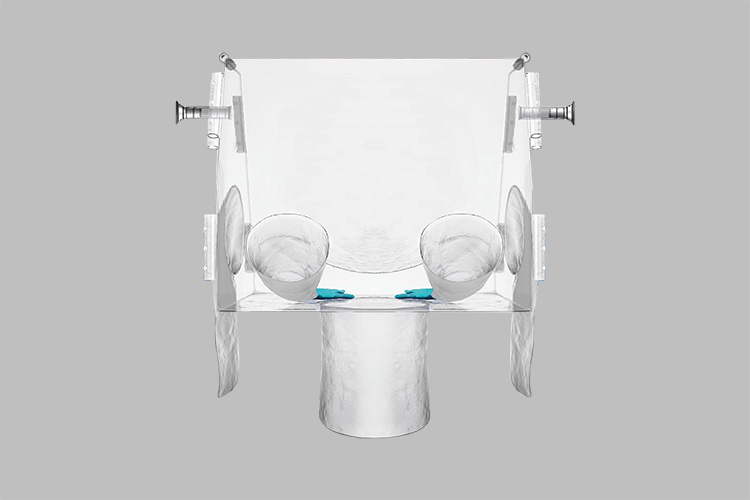
Pop-Up benchtop Isolator、Plug-and-Play Isolator
That is the honest limitation. A flexible isolator gives you a controlled micro-environment, not a classified room. Particle counts inside depend on the supply filter, the film's cleanliness, and how often the enclosure is opened.
Where Soft-Wall Stops Being the Right Answer
Choose a rigid stainless isolator instead when the process needs continuous hydrogen peroxide vapor decontamination at high concentration, when solvent exposure will attack the film, when the working volume exceeds roughly two cubic meters, or when the enclosure must serve as the room's primary containment barrier for a highly potent compound at production scale.
For everything else — bench-scale weighing, sample handling, small-volume filling, sterile connection work — a flexible isolator deploys in a day instead of a quarter, and it costs a fraction of the stainless alternative.
Sizing the Enclosure Around the Task
Operators usually specify an isolator by outer dimension and then discover the working volume is wrong. Start from the task instead.
Reach, Not Volume
Measure the distance from the glove port plane to the furthest object the operator must touch. Beyond about 500 mm, control drops sharply and the operator starts leaning on the film, which loads the seams. If the task needs more depth than that, add a half-suit or move to a walk-in design rather than stretching the gloves.
Height matters as much. A benchtop isolator sized for seated work is uncomfortable for standing operators, and the reverse. Harmake's desktop flexible isolator and the pop-up benchtop and plug-and-play variants exist precisely because bench height, available footprint and deployment speed differ between a QC lab and a dispensing booth.
Transfer In and Out
Every isolator has to let material cross the sterile boundary. The options, in rough order of containment strength:
|
Transfer method |
Containment |
Typical use |
|
Rapid transfer port (RTP) with alpha/beta valve |
Highest |
Potent compounds, closed transfer between vessels |
|
Sterile continuous bag sleeve |
High, continuous |
Powder discharge from an isolator or hopper |
|
Double-bagged pass-through with surface disinfection |
Moderate |
Small components, consumables |
|
Glove port manipulation |
Low |
Single items, non-potent material |
The transfer choice should be made before the enclosure is ordered, because port location, sleeve diameter and frame cut-outs all follow from it. A
flexible isolator with no planned transfer path becomes a box that must be opened — which defeats the purpose.
Running the Isolator Day to Day
Leak and Integrity Testing
A soft-wall enclosure is tested by pressure decay. The unit is brought to a defined test pressure, isolated, and the pressure loss over a set period is compared with the acceptance limit. Do this at installation, after any film or glove change, and on a fixed interval thereafter.
Gloves are the usual failure point. Test them individually, inspect the cuff seal, and replace on a schedule rather than on visible damage — pinholes appear long before a glove looks worn.
Cleaning and Changeover
Sequence matters: remove loose powder first with a wet wipe, then disinfect, then let the surfaces dry before closing the unit down. Trapped moisture under a folded film is where microbial growth starts. Between products, the film itself should be inspected for staining, crazing and seam lift, because a compromised seam is invisible under normal lighting.
Operator Technique
Two habits separate a clean run from a contaminated one. First, never let a gloved hand touch the outside of the film and then return to the work zone. Second, work from clean to dirty within the enclosure and keep the transfer port area as the last thing touched.
Specification Checklist Before Ordering
|
Item |
What to confirm |
|
Working volume |
Height, width and depth measured to the actual task, not the bench |
|
Glove port layout |
Diameter, spacing, sleeve length, cuff seal type |
|
Air system |
HEPA class, supply and exhaust arrangement, pressure regime |
|
Transfer interface |
RTP size, continuous bag sleeve diameter, or pass-through |
|
Film material |
Chemical compatibility with process solvents and disinfectants |
|
Frame |
Folding or fixed, floor-standing or benchtop, castor options |
|
Documentation |
Leak test record, filter certificate, material statement |
Harmake supplies
flexible isolators together with the sterile continuous bags, transfer sleeves and single-use process bags that connect to them, which means the transfer path can be specified as one system rather than assembled from three suppliers. For a process that is still being defined, that is worth more than a marginal difference in enclosure price.
The Short Version
A flexible isolator earns its place when the task is bounded, the containment requirement is real but not extreme, and speed of deployment matters. Size it from the reach and the transfer path, test it on a schedule, and treat the gloves as the consumable that decides your contamination rate. Everything else is detail.
Wuxi Harmake Technology Co., Ltd. manufactures containment, transfer and single-use consumables for biopharmaceutical and small molecule production, and supplies flexible isolators into pharmaceutical and laboratory environments from its base in Wuxi, Jiangsu.